


As time evolved, the design also evolved giving the latest offering that Aprilia has. Some of the key features that one can thrive for are:

 Posts
All Comments
Posts
All Comments
We all know that MOTOGP is one of the toughest races in the world that demands more from the man as well as the machine. In the case of the machine we will be aware of the technologies involved in shaping the machine for the circuit and the amount of hard work put in to make the machine a winning history.

But are we aware of the process that the riders are being put through before the racing season??? Now, please don’t think that the riders are celebrities and they come only a day before the season to tune their bikes according to their needs and then start practicing and then qualifying and finally race. There are much more than that, all riders have to undergo some of the toughest physical training and tests to take part in a race and this training depends on the climatic conditions, track conditions, the stress level exhibited in the race and much more. Let’s take a sneak peek into the training process.
PERIOD OF COMPETETION: This session depends on the proximity of a GP race. The training during this part of the year is any one of the two types: If there is a free week without a race then the physical work is completely aimed at increasing the muscle volume but if there is a week with a race then the muscle volume work-out’s will be lower but with raised intensity. This continues for two to three months and gradually the amount of work to increase the physical volume is reduced and again the intensity will be increased. This is again accompanied by introducing more specific work depending on the needs of the rider himself.
REST: This is one of the main thing that a rider must get after all the above mentioned work out’s. The team will ensure that the rider gets 8 hrs sleep a day which is vital, missing that the rider will be subjected to tiredness and fatigue which when happens during the race can be disastrous to himself as well as the others on the circuit. If the rider needs some more rest, then the team will also ensure that the rider takes a small afternoon naps to refresh his mind and body. These are the vigorous tests that each and every MOTOGP rider is subjected before hopping on to their monsters with some X amount of Bhp’s and Torque that can top an excess of whopping 320 kmph or more in just a few seconds. Pretty easy on papers isn’t it??
What is a HID: A simple abbreviation of HID is High Intensity Discharge. A halogen bulb consists of a normal filament resembling a normal bulb but with some inert gas surrounding it, when current applied at the hot and the cold terminals the filament glows brightly producing light. In contrast the HID bulbs has not filaments at all, but instead consists of Xenon gas, mercury and metal halide salts that are ignited by an arc of high voltage current that glows brightly.

The high voltage that is required by the bulb for arching is generally produced by Ballast that works on DC power. Although these HIDs sometime before were to be found only in expensive and exotic cars, now they have come with different pricing and technical options that can be easily installed in today’s Motorcycles as well.
Why Install HID’s When I have Halogen: Although this is purely a personal choice HIDs produce 300% more light than normal halogen that gives great illumination in the nights that are really helpful for tourers. HIDs can also produce two different beams namely the Hi and Lo from a single bulb by a small magnetic solenoid that moves forth and back and are known as Bi-Xenons that can be used for vehicles carrying the bulb type H4. There are also single beam xenon’s that can be installed in H4’s.
Color Options Available in HIDs: There are plenty of color options available from some of the unknown manufacturers ranging from golden yellow to bright pink. But generally 4100K where K is the unit of color temperature which gives out Bright Daylight white and 6000K which is bright white is permitted in most of the countries. There are also other manufacturers who produce HIDs with a color temperature ranging from 4100K to 30000K but anything above 6000k is illegal in any country. The more the Kelvin the more bluish the light will be and the end results will be more fatigue resulting to some nasty disasters at night. That’s the reason why company manufacturers stick to 4100K and 6000K.

Can I Install HIDs in My Current Bike? The answer is yes; of course you can install it in your current bike, with lots of aftermarket HID conversion kits available in the market today but conditions apply satisfying some of the main factors. The Battery, the more the amps the better it is, minimum 12V 9A battery will do the job perfectly. Although it is illegal in India to use HIDs without projectors one can install the HIDs with the given LOBES that minimizes the direct contact of the light source to on-coming vehicles thus minimizing distractions. The advisable color range is always 4100K where there is abundant light that can be used. The more the Kelvin the less the light on road because of the reflections and always remember the higher Kelvin range HIDs are cop magnets. The last one is the bulb type as most of us carry is H4 generic and only Pulsar 220 has H7 that is of a car’s model anyone can install it specifying the type of the bulb.
How Are HIDs Priced: This is where a lot of people back-off considering its price. Yes, HIDs are a bit expensive, they cost from a mere 2500 rupees to a whopping 12000 rupees for bikes and same for the cars depending on the quality of the product. The Chinese ones will be the most inexpensive but branded ones like Philips and Osram will cost you more than 6000 rupees and they go all the way up to 12000 but as they are OEM manufacturers they do not exceed 6000K for safety purpose. But, investing in HIDs is a wise investment that one will never regret later for the amount of illumination and the life hours it is always worth every penny.

What Should I Look Into While Buying HIDs? The first and foremost thing is the brand, although Chinese ones are cheaper they are not worth even that money as they can trouble you from day one as they don’t carry a warranty with them. Branded HID conversion kits come with a standard one year warranty that can be replaced with the new ones if they are found to be defective in nature. The second thing is the Kelvin color temperature; do not exceed 6000K as anything above 6000K is illegal and the best known cop magnets.
Inside The Box You Will Find: One HID bulb, one wiring Harness, one Ballast with built-in igniter and one relay.Although HIDs are a boon over the conventional halogens, these should be treated and used in the way it is meant to be as using technology in illegal ways can lead to some nasty disasters.
- Ram

BAJAJ AUTO is gearing up the scooter again with their all new BAJAJ BLADE.. Though there are no reviews as of now. here goes the specs:

 VEHICLE SUMMARY
Name: Blade 125
Model: DTSi
Type: Scooterette
Top Speed: 95kph
ENGINE SPECIFICATIONS
Displacement: 125cc
Engine: 4 valve DTS-i
Maximum Power: 11.5 Bhp
Gears: 4 Speed
Cooling Type: Air Cooling
OTHER SPECIFICATIONS
Weight: 163.00 kg
Ground Clearance: 140.00 mm
Fuel Tank: 14.50 ltrs
Wheelbase: 1370.00 mm
Wheel Type: 12" Alloys
Wheel Size: 3.25x19", Rear 3.50x19" mm
Tubeless: Y
Colors: Red
ACTIVE AND PASSIVE SAFETY
Suspension(Front): Telescopic hydraulic absorbers
Suspension(Rear): Pivoted fork with Absorbers
Brakes: Disc
Brakes(Rear): Drum
Stand Alarm: NA
COMFORT AND CONVENIENCE
Fuel Guage: Analogue
Self Start:
Tacho Meter: Analogue
Trip Meter: None
Alloys: Y
Speedometer: Analogue
Passenger Footrest: Y
Passenger Backrest: Y
Step-up Seat: NA
Pass-light: Y
Low Fuel Indicator: Y
Low Oil Indicator: Y
Low Battery Indicator: Y
High Oil Temp. Indicator: Y
Choked Air Filter Indicator:Y

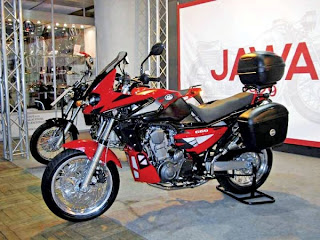
The Czech manufacturer announced an all-new bike on its 80th birthday
All of you, who think that the Jawa brand went extinct after its short run in the country, get this. The Czech brand, though well past its glory days, has managed to survive thanks to its ardent fans. In fact, Jawa is actually celebrating its 80th anniversary this year.
The bike will be available in regular as well as touring versions. The latter gets a bigger windshield and a set of three luggage cases. The 650 Dakar will be available from 2010 onwards.

The scooter is available in 5 colors – black, red, blue, pink and mauve, all designed to impress its target segment – teen youth. Moreover, the brand ambassador for the TVS Scooty Streak is Sania Mirza, the youth icon, a strategy sure woo the target segment.


Yes, After lots of delay, finally Bajaj announced that they will launch Kawasaki Ninja 250R in May-june this year. Kawasaki Ninja 250 is one of the most selling bike from the stable of Kawasaki. The bike throughout the world is known for its power and fuel efficiency combination. Other feature which makes this bike a popular toy among the experience bikers its light handling as well as its comfort. Can be considered a entry level sports bike but making good statement as street bike too.

Transmission:
Transmission Type Manual
Number Of Speeds 6
Primary Drive (Rear Wheel) Chain
Wheels & Tires:
Front Tire (Full Spec) 110/70 R17
Rear Tire (Full Spec) 130/70 R17
Brakes:
Front Brake Type Hydraulic Disc
Rear Brake Type Disc
Technical Specifications:
Wheelbase (in/mm) 55.1 / 1399.5
Fuel Capacity (gal/l) 4.8 / 18.2
COLOURS AVAILABLE:


Yamaha now has no plan to concentrate on the commuter or 100 cc segment anymore.
YZF R1

 SPECS:
Engine:
Engine Type Horizontal In-line
Cylinders 4
Engine Stroke 4-Stroke
Cooling Liquid
Valves 16
Valves Per Cylinder 4
Valve Configuration DOHC
Compression Ratio 12.7:1
Starter Electric
Fuel Requirements Regular
Fuel Type Gas
Transmission:
Transmission Type Manual
Number Of Speeds 6
Primary Drive (Rear Wheel) Chain
Wheels & Tires:
Front Tire (Full Spec) Pirelli® 120/70 ZR17
Rear Tire (Full Spec) Pirelli® 190/50 ZR17
Brakes:
Front Brake Type Dual Hydraulic Disc
Rear Brake Type Hydraulic Disc
Technical Specifications:
Wheelbase (in/mm) 55.7 / 1414.8
Fuel Capacity (gal/l) 4.75 / 18
YAMAHA MTO1


 SPECS:
Model: Yamaha MT-01
Year: 2005
Category: Naked bike
Rating: 75.2 out of 100.
Engine and transmission
Displacement: 1670.00 ccm (101.90 cubic inches)
Engine type: V2
Stroke: 4
Power: 90.00 HP (65.7 kW)) @ 4750 RPM
Torque: 150.10 Nm (15.3 kgf-m or 110.7 ft.lbs) @ 3750 RPM
Compression: 8.4:1
Bore x stroke: 97.0 x 113.0 mm (3.8 x 4.4 inches)
Fuel system: Injection
Valves per cylinder: 4
Fuel control: OHV
Starter: Electric
Lubrication system: Dry sump
Cooling system: Air
Gearbox: 5-speed
Transmission type
final drive: Chain
Clutch: Wet, multiple-disc
Physical measures
Dry weight: 240.0 kg (529.1 pounds)
Front percentage of weight: 47.0
Rear percentage of weight: 53.0
Overall height: 825 mm (32.5 inches)
Overall length: 2,185 mm (86.0 inches)
Overall width: 790 mm (31.1 inches)
Ground clearance: 140 mm (5.5 inches)
Wheelbase: 1,525 mm (60.0 inches)
Chassis and dimensions
Frame type: Newly designed aluminium CF die-cast sports frame, R1-type die-cast aluminium subframe
Rake (fork angle): 25.0°
Trail: 103 mm (4.1 inches)
Front suspension: Fully-adjustable R1-derived upside down 43mm forks
Front suspension travel: 120 mm (4.7 inches)
Rear suspension: Horizontal fully-adjustable rear shock
Rear suspension travel: 117 mm (4.6 inches)
Front tyre dimensions: 120/70-ZR17 M/C (58W)
Rear tyre dimensions: 190/50-ZR17 M/C (73W)
Front brakes: Double disc
Front brakes diameter: 320 mm (12.6 inches)
Rear brakes: Single disc
Rear brakes diameter: 267 mm (10.5 inches)
Speed and acceleration
Power/weight ratio: 0.3750 HP/kg
Other specifications
Fuel capacity: 15.00 litres (3.96 gallons)
Reserve fuel capacity: 3.00 litres (0.79 gallons)
Speed and acceleration
Power/weight ratio: 0.3750 HP/kg
Others
Other specifications
Fuel capacity: 15.00 litres (3.96 gallons)
Reserve fuel capacity: 3.00 litres (0.79 gallons)


Honda Motorcycle & Scooter India (HMSI) has had an aggressive growth path for itself in the fast-growing bike segment. It now plans to launch a 100cc bike by December and introduce five more models in three years with the objective of en cashing on the growing opportunities in the bike market.
Talking about the proposed move and confirming the same Mr. Naresh Kumar Rattan, operating head, Sales & Marketing, HMSI, said, “The bike segment is a good business for us and we would be focusing on it. We expect to grow in the bike space by 25% by next year.” He declined to reveal the details of the new models and the segments they would be considered. “We cannot speak about our upcoming products now.”
HMSI is renowned in India for the Honda Activa, its gearless scooter. The intention now is to have a significant presence in the bike segment where it is a marginal player. The company presently offers three bikes namely Unicorn, Shine and Stunner. In the year 2008-09, HMSI has sold over five lakh bikes which is up 40% from 2007-08. Overall, HMSI sold 10.7 lakh two-wheelers (bikes and scooters) during FY09. The company has now set itself a target to produce 12.5 lakh two wheelers for 2009-10.
HMSI has very recently entered the fun bike segment with the launch of the CBR 1000RR Fireblade and CB1000R models which are at the higher end segment. These are in the Rs 9.5-12.5 lakh price range. The company also has plans to increase its dealership and branches. With the intention to grow in the bike segment, HMSI will be up against Hero Honda where Honda is a joint venture partner.
Hero Honda is presently the biggest player in the bike segment with a 40% market share. Though HMSI officials say their existing models and those in the pipeline are not in the same segment as that of Hero Honda’s, they will compete for the same customer.
According to the Society of Indian Automobile Manufacturers (SIAM), two wheelers constitute three-fourths of the total number of vehicles sold in the domestic market. Hero Honda is the market leader and is followed by Bajaj and TVS in the domestic market. HMSI is one of the major players in the automatic gear scooter segment. HMSI, on Tuesday, launched a 110cc variant of Honda Activa for the Western market.


Identification
Transmission:
Transmission Type Manual
Number Of Speeds 6
Primary Drive (Rear Wheel) Chain
Reverse No
Wheels & Tires:
Wheels Composition Aluminum
Tube / Tubeless Tubeless
Front Wheel Width (in) 3.5
Rear Wheel Width (in) 6
Chromed No
Front Tire Width 120
Front Tire Aspect Ratio 70
Front Tire Speed Rating Z
Front Wheel Diameter 17
Rear Tire Width 190
Rear Tire Aspect Ratio 50
Rear Tire Speed Rating Z
Rear Wheel Diameter 17
Front Tire (Full Spec) 120/70 ZR17
Rear Tire (Full Spec) 190/50 ZR17
Brakes:
Front Brake Type Dual Disc
Front Brake Diameter (in/mm) 12.6 / 320
Front Caliper Pistons 4
Rear Brake Type Disc
Rear Brake Diameter (in/mm) 8.7 / 220
Rear Caliper Pistons 1
Anti-Lock Brakes Standard
Suspension:
Front Suspension Type Inverted Fork
Front Suspension Size (in/mm) 1.7 / 43
Front Travel (in/mm) 4.3 / 109.2
Front Adjustable Fork Pre-Load Yes
Front Adjustable Rebound Damping Yes
Front Central Suspension Strut No
Steering Damper Yes
Rear Suspension Type Twin Sided Swing Arm
Rear Travel (in/mm) 5.4 / 137.2
Rear Adjustable Shock / Spring Pre-Load Yes
Rear Adjustable Rebound Damping Yes
Number Rear Shock Absorbers 1
Rear Suspension Brand Name Unit Pro Link™
Rear Suspension Material Aluminum
Air Adjustable No
Steering:
Steering Control Handlebar
Technical Specifications:
Wheelbase (in/mm) 55.4 / 1407.2
Rake (degrees) 23.3
Trail (in/mm) 3.8 / 96.2
Wet Weight (lbs/kg) 461.7 / 209.4
Fuel Capacity (gal/l) 4.7 / 17.8
Fuel Capacity Reserve (gal/l) 1.06 / 4
Performance Standard
Seats:
Seat Type Two-Piece
Adjustable No
Seat Material Vinyl
Seat Location Driver and Passenger
Folding No
Seat Height (in/mm) 32.3 / 820.4
Number Of Seats 2
Grab Rail or Strap Standard
Exterior:
Frame Aluminum
Body Material Plastic
Hand Grip Material Rubber
Foot Peg Location Driver and Passenger
Drive Shaft Guard No
Fork Guards Yes
Saddle Bag Guard No
Belt Guard No
Hand Guards No
Brush Guard No
Light Guard No
Fuel Tank Cover Yes
Front Fender Material Plastic
Rear Fender Material Plastic
Top Crown Standard
Stand Type Kick
Lower Fairing Standard
Spoiler Standard
Handlebars Standard
Upper Fairing Standard
License Plate Standard
Instrumentation:
Digital Instrumentation Standard
Clock Standard
Tachometer Standard
Trip Odometer Standard
Trip Computer Standard
Speedometer Standard
Temperature Warning Type Gauge
Fuel Level Warning Type Gauge
Pricing:
Warranty (Condition) Limited
Zero Price Schema 0
NADA Value Average 0
NADA Value Low 0
NADA Value High 0
Identification:
Generic Type (Primary) Sport
Manufacturer Country Japan
Introduction Year 2009
MIC Model Segment ON-HWY Sport Bike Over 750cc
NADATrimID 33111
CRS -> NADA Map 6200024339
Mounts:
Windshield Mounts Standard
Paint & Finish:
Paint Standard
Glass:
Folding Yes
Windshield Lowers No
Height Adjustable No
Tinted Yes
Height Low
Storage:
Underseat Storage Standard
Lights:
Headlight Mounts Standard
Halogen Headlight (s) Standard
Convenience:
Handlebar Lock Standard
 CB 1000R
The CB1000R is a whole new bag for Honda. A bike designed with Europe in mind and one that uses a retuned version of the ‘07 CBR1000RR engine and runs ‘08 Fireblade forks, ‘08 Fireblade brakes, a beautiful single-sided swingarm and styling tailored to the decor of the very best designer cafes in Milan
Then there’s the short, stubby attitude of the CB1000R: the tiny seat unit designed as a token gesture to attract nubile young goddesses who may want to perch on your steed, so to speak. In reality no real human would want to sit on the back and you’d never get a tail pack on it, but Honda designed it that way. It’s all about being aggressive, minimal, and saying to everyone watching that hey, I’m a no-compromise kind of person who likes to ride fast and look good (well, as good as you can look when you resemble a Manatee!).
The CB1000R weighs in wet at 217kg, which is just 18kg more than the super lightweight 2008 Blade, and most of that extra weight is in the heavily braced single-sided swingarm.
Scope out that swoopy four-spoke rear wheel, the LCD clocks that are claimed to be the most expensive Honda makes, the jagged lines of the bodywork and the aggressive ‘angry alien here to destroy’ stance, and you can tell this is no normal Japanese naked bike. It’s designed to give a sporty ride with the stylish looks of a naked, and believe me it more than delivers the goods.


 The CB1000R is a serious bit of kit that aims to do a totally different job to that of the old Hornet 900, and out on the road the bike is gentle, easy and torquey. The fuelling is perfect, the grunt is huge. One hundred and thirty horsepower is heaps but it’s more about the torque and the way the power is delivered that impressed yours truly. It comes on clean and chunky to the point where sixth gear will pull 50kph with no quivers from the transmission; no rattles, just tidy, clean drive. Try that on most other nudes and you’ll be reaching for an inhaler to spray down its air intakes. Hit 8000rpm and there’s no noticeable switch in delivery but by then it’s pulling at its peak and doesn’t ease off till it hits the 10 thou mark.
Hitting the motorway and the CB1000R comes into its own. You can feel how agile it is when cutting through traffic. It steers quickly, yet the boffins behind the bike have managed to make it stable at speed – quite a feat when you consider how quickly it turns into a corner. Sit at 120kph and the Honda is surprisingly comfortable. You feel close to the headstock of the bike, yet deep enough in the seat to not feel the full force of the wind.
Where the CB1000R really comes into its own is on nice, tight, flowing roads and it’s here where it likes to live. The big Honda is so easy to ride fast that you really don’t have to think about what gear and when to get on the throttle. It seems to let you get away with riding the road and not thinking about the bike. The Honda fair leaps out of corners, putting all of its torque to the ground and is round the rev-counter before you know it. Shift at 10,000rpm and it feels like the perfect blend of power and torque for the road.
The suspension is softer than the Triumph but, for me, gives the perfect blend of feel and comfort. I don’t want a bike that’s too hard, just one that lets me know what the wheels are doing and doesn’t pitch around under power or braking. The only thing the CB1000R lacks is a bit of soul and the noise that you get from the Brutale and the Speed Triple. But for the real world, where cops are hiding in bushes with speed guns and decibel counters, the roads are getting ever busier and a sizable portion of said roads resemble a patchwork quilt, Honda has come up with a brilliant naked bike.
Specifications
Engine type: Liquid-cooled four-stroke 16-valve DOHC inline-four
Displacement: 998cc
Bore x stroke: 75 x 56.5mm
Carburation: PGM-FI electronic fuel injection
Ignition: Computer-controlled digital transistorised with electronic advance
Suspension: Front: 43mm inverted HMAS cartridge-type telescopic fork with stepless preload, compression and rebound adjustment, 120mm cushion stroke
Suspension: Rear: Monoshock with gas-charged HMSA damper featuring 10-step preload and stepless rebound damping adjustment, 128mm axle travel
Front brakes: 310 x 4.5mm dual hydraulic disc with four-piston callipers, floating rotors and sintered metal pads
Rear brakes: 256 x 5mm hydraulic disc with dual-piston caliper and sintered metal pads
Front tyres: 120/70 R17
Rear tyres: 180/55 R17
Wheelbase: 1445mm
Seat height: 828mm
Ground clearance: 130mm
Fuel capacity: 17 litres (including four-litre LCD indicated reserve)
Dimensions: 2090 x 775 x 1090mm


“The limited edition Unicorn Grand Prix Edition is derived from Honda’s racing DNA and the new sporty graphics reflect true racing attitude.” according to Honda. 3500 limited edition bikes will be built and will retail at Rs. 59,290 Ex-Showroom Delhi.
SPECS:
VEHICLE SUMMARY
Name: Unicorn Grandprix GP
Type: Sports
Top Speed: 101kph
ENGINE SPECIFICATIONS
Displacement: 149.1cc
Engine: 4 Stroke, Air Cooled OHC, Single Cylinder
Maximum Power: 13.3bhp@8000rpm
Maximum Torque: 1.3kgm@5500rpm
Gears: 5 Speed
Clutch: 0
Bore: 57.3
Stroke: 57.8
Cylinder Configuration: NA
Engine Block Material: NA
Chassis Type: NA
Cooling Type: Air Cooling
Carburetor: CV Type
0 to 60: 5.00 sec.
DIMENSIONS
Length: 2095.00 mm
Width: 750.00 mm
Height: 1100.00 mm
OTHER SPECIFICATIONS
Weight: 146.00 kg
Ground Clearance: 168.00 mm
Fuel Tank: 13.00 ltrs
Wheelbase: 1340.00 mm
Electrical System: NA
Headlamp: Halogen (12V/35W)
Battery Type: 12V - 2.5 Ah(Kick) / 12V - 7 Ah(Self)
Battery Capacity: 12V
Horn: NA
Wheel Size: 2.75 x 18", 3.00 X 18" mm
Tubeless:
Colors: Available in White, Blue & Green Combination with Black Alloys
ACTIVE AND PASSIVE SAFETY
Suspension(Front): Telescopic
Suspension(Rear): Advanced Technology Mono-suspension
Brakes: 240mm Disc
Brakes(Rear): 130 mm Drum
Stand Alarm:
COMFORT AND CONVENIENCE
Fuel Guage: Analogue
Self Start: Y
Tacho Meter: Analogue
Trip Meter: Analogue-1
Alloys: Y
Warranty: NA
Speedometer: Analogue
Passenger Footrest: Y
Passenger Backrest: NA
Step-up Seat: NA
Pass-light:Y
Low Fuel Indicator: Y
Low Oil Indicator: NA
Low Battery Indicator: NA
High Oil Temp. Indicator: NA
Choked Air Filter Indicator:NA

Yamaha fazer 1000

Spotted Yamaha Fazer 150
Yamaha Fazer was caught to be tested on road. Those who dislike the naked headlight of FZ16 or even dislike the look of FZ-S, they will be provided with new option, Fazer 150!! As Fazer is now being tested, we may expect its launch in near future, though there is no official announcement about Fazer 150.
Pawan Munjal, CEO, Hero Honda said it will launch 12 new bikes across entry executive premium segment, reports MoneyControl.Com".
 Mr. Pawan Munjal (center) at the launch of the CBZ Xtreme
"Between the expos of 2006 –08, we had 18 launches.
Going forward, in the next 18 months, we have 12 new launches and are looking at all three segments.
We have focus on all the three segments and more and more on the premium, the youth and on the youngsters," said Pawan Munjal, CEO, Hero Honda Motors.
The Bullet 500 Electra EFI is right now an import only model and will soon make its appearence on foreign shores soon.
%5Boriginal%5D.JPG)
Apart from Fuel Injection, The Bullet 500 Electra EFI also features a Unit Construction Engine (Engine-Gearbox in a single block) and a more conventional left side gear shifter.. which sets this particular model apart from previous Royal Enfield models.
%5Boriginal%5D.JPG)
%5Boriginal%5D.JPG)
The Bullet 500 Electra EFI is right now an export only model.. The classic looking speedometer shows the reading in MPH (miles per hour). The Bullet 500 Electra also "Probably" features a twin spark plug like design on its single cylinder engine..
The 500 Electra EFI also features front discs and a gas filled rear suspension.
%5Boriginal%5D.JPG)
There are news of a 350 cc engine with similar Unit Construction Engine (without the Fuel Injection) that is being prepared for an India launch..!!
%5Boriginal%5D.JPG)
Technical Specifications of the Royal Enfield Bullet 500 Electra EFI:
Engine:
4 Stroke Single Cylinder
Capacity: 499 cc
Max Power: 30 hp
Electronic fuel injection
Kick and Electric start
5 Gears
Suspension
Front: Telescopic front Forks
Rear: Gas Filled, 5 stage Adjustable
Brakes
Front: 280 mm disk with dual-piston caliper
Rear: 153 mm drum
Wheels
Front: 90/90 X 19 '
Rear: 100/90 X 19 '
Capacity, weights and dimensions
Fuel Tank of 14.5 lts (reserve 1.5 lts)
Weight 180 kg in running order
Length of 2200 cm
Width of 790 mm
Seat height of 820 mm
Fuel Consumption: 3.3 lts/100km
Price: 5,990 € (Euros)


